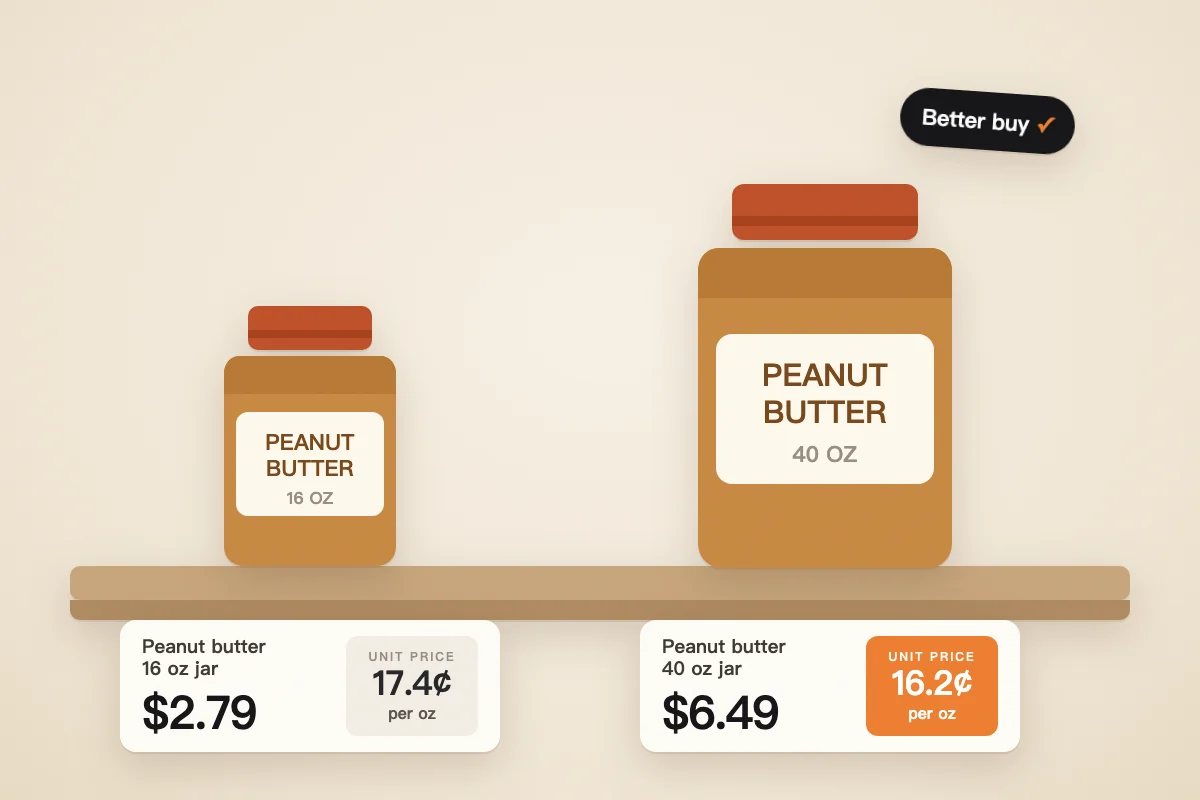
Unit price = price ÷ quantity.
Divide what the package costs by how much is in it, using the same unit for every package you compare. A 16 oz jar of peanut butter at $2.79 is 17.4¢ an ounce. A 40 oz jar at $6.49 is 16.2¢ an ounce, so the big jar costs about 7% less per ounce.
Many US grocery shelf tags already print a unit price. But tags in the same aisle don’t always use the same unit, sale signs sometimes leave the unit price off, and multipacks and “2 for $5” deals need the arithmetic done again. The calculator below compares up to six packages at once. The rest of the page shows the math, so you can check a tag in the aisle with a phone calculator.
Unit price calculator
For each package, enter the price, how many packages that price buys, and the size of one package. Packages sold by weight are compared with other weights, liquids with liquid volume, and pieces by count. The first two lines are the peanut butter example above.
How to calculate unit price by hand
It takes three steps, and the second is where most mistakes happen.
- Find the total quantity. For one package, that’s the size on the label. For a multipack or a “2 for” deal, multiply: two 15 oz cans for $5 is 30 oz for $5.
- Put every package in the same unit. 1 pound is 16 ounces, 1 kilogram is about 35.27 ounces and 100 grams about 3.53 ounces. For liquids, 1 quart is 32 fluid ounces, 1 gallon is 128 and 1 liter about 33.8.
- Divide the price by the quantity. $5 ÷ 30 oz = 16.7¢ per ounce.
Watch the difference between ounces and fluid ounces. The “oz” on a box of cereal is a weight; the “fl oz” on a bottle of oil or juice is a volume. Compare weight with weight and volume with volume. If two packages of the same food are labeled different ways, convert one using the ingredient’s weight per cup; our recipe measurement conversion chart lists the common ones.
Things sold by the piece work the same way. Five jalapeños for $1 is 20¢ each, so if loose ones are 25¢ apiece, the bundle wins.
Which is the better buy? Four examples
The bigger package usually has the lower unit price, but not always. Sales and multipacks are where it flips.
| Product | Option A | Option B | Better buy |
|---|---|---|---|
| Peanut butter | 16 oz jar, $2.79: 17.4¢/oz | 40 oz jar, $6.49: 16.2¢/oz | 40 oz jar, 7% less per ounce |
| Breakfast cereal | 12 oz box on sale, 2 for $6: 25.0¢/oz | 18 oz family size, $5.49: 30.5¢/oz | 12 oz box, 18% less per ounce |
| Canned beans | One 15 oz can, $1.19: 7.9¢/oz | 4-pack of 15 oz cans, $5.29: 8.8¢/oz | Single cans: four cost $4.76, 53¢ less than the 4-pack |
| Olive oil | 16.9 fl oz bottle, $8.99: 53.2¢/fl oz | 1 L bottle (33.8 fl oz), $15.99: 47.3¢/fl oz | 1 L bottle, 11% less per fluid ounce, if you’ll use it up |
The cereal shows what a sale does: the discount lands on the smaller box, and its unit price drops below the family size. The beans show the multipack trap, where four cans in shrink-wrap cost more per ounce than four loose ones. Neither is obvious from the price tags alone. You only see it by comparing unit prices in the same unit.
How to read the unit price on a shelf tag
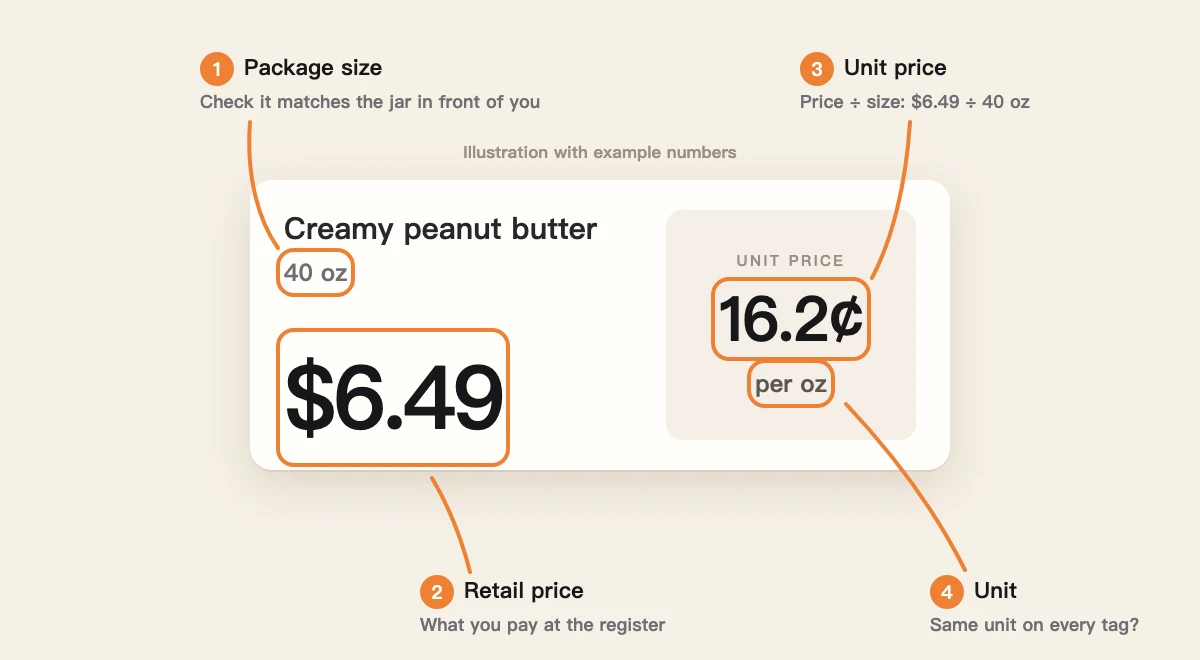
On most US shelf tags, the unit price is the smaller number, often in a box or a corner, with its unit next to it: per oz, per lb, per fl oz or per count. Read the unit before the number. If one jar’s tag says $2.60 per lb and the other’s says 17.4¢ per oz, convert before you decide: 17.4¢ × 16 is $2.79 per pound, so the per-pound jar is the cheaper one.
There’s no federal rule requiring unit prices. According to the National Institute of Standards and Technology’s 2025 Unit Pricing Guide, 16 states and three territories have unit pricing laws or regulations. Elsewhere, stores that show unit prices do it voluntarily. NIST recommends that every brand and size in a product category use the same unit. It also says “loads,” “uses” and “servings” are not acceptable units of measure, so a detergent tag priced per load isn’t following its guide.
A few checks before you trust a tag:
- The units match across the products you’re comparing. If they don’t, convert one, or put both into the calculator.
- The size on the tag matches the package in front of you, especially on shelves that hold two sizes of the same product.
- Sale prices are recalculated. Work out the unit price from the sale price yourself. NIST’s examples of label problems include sale tags with a missing or wrong unit price.
The calculator rounds the way NIST’s guide describes: unit prices of a dollar or more to the nearest cent, and smaller ones to a tenth of a cent.
When the lower unit price isn’t the better buy
A unit price tells you what the food costs on the shelf, not what it costs once some of it ends up in the trash. Before you reach for the bigger size, ask a few questions.
Will you use all of it?
Price it on what you’ll actually eat. A 5 lb bag of potatoes at $3.99 is 80¢ a pound, against $1.29 a pound loose. If half the bag goes soft before you get to it, the 2.5 lb you ate cost $1.60 a pound, more than buying loose. It’s the same thinking as deciding whether to count the rest of a package in our guide to pricing a recipe.
Are you comparing the same thing?
A store brand and a name brand, or a regular and an organic version, can have very different unit prices for reasons that matter to you. Compare like with like first, then decide whether the difference is worth paying.
Do you have the room and the cash?
A bulk buy costs more at the register even when it saves per ounce, and it needs a place to live. For pantry staples you go through quickly, like rice, oats, beans or oil, the bigger size is often worth it. For things you use a spoonful at a time, it often isn’t.
From unit price to cost per serving
A unit price is also the first step in pricing a recipe: multiply it by the amount the recipe uses. Our conversion chart lists ½ cup of peanut butter at 135 g, so 2 tablespoons weigh about 34 g, or 1.2 oz. At 16.2¢ an ounce, the peanut butter in a sauce that uses 2 tablespoons costs about 19¢.
Do that for every ingredient, add the lines up and divide by the number of servings, and you have the cost per serving. Our guide to calculating the cost per serving of a recipe walks through a whole pot of chili and has its own cost per serving calculator.
If you’d rather not price every line, Hireci estimates the cost of each recipe you save in the app: the total, the cost per serving and a cost for each ingredient line, from a US baseline ingredient price table. It’s an estimate, since real prices vary by brand, store, location and season, and it’s free to view. The app is free to download for iPhone, iPad and Android.
Frequently asked questions
How do you calculate price per ounce?
Divide the price by the number of ounces in the package. A 40 oz jar at $6.49 is $6.49 ÷ 40 = 16.2¢ per ounce. If the size is in pounds, multiply by 16 first to get ounces.
Is the bigger size always cheaper?
No. A sale on the smaller size can push its unit price below the bigger one, and multipacks sometimes cost more per ounce than buying the same number of single packages. Compare unit prices in the same unit to be sure.
How do I compare a price per pound with a price per ounce?
Convert one of them. Multiply a price per ounce by 16 to get the price per pound, or divide a price per pound by 16 to get the price per ounce. 17.4¢ per ounce is $2.79 per pound.
What’s the difference between unit price and cost per serving?
Unit price is the cost per ounce, pound, fluid ounce or item of what’s in the package. Cost per serving is what one portion of a finished dish costs, which depends on how much of each ingredient the recipe uses and how many servings it makes.