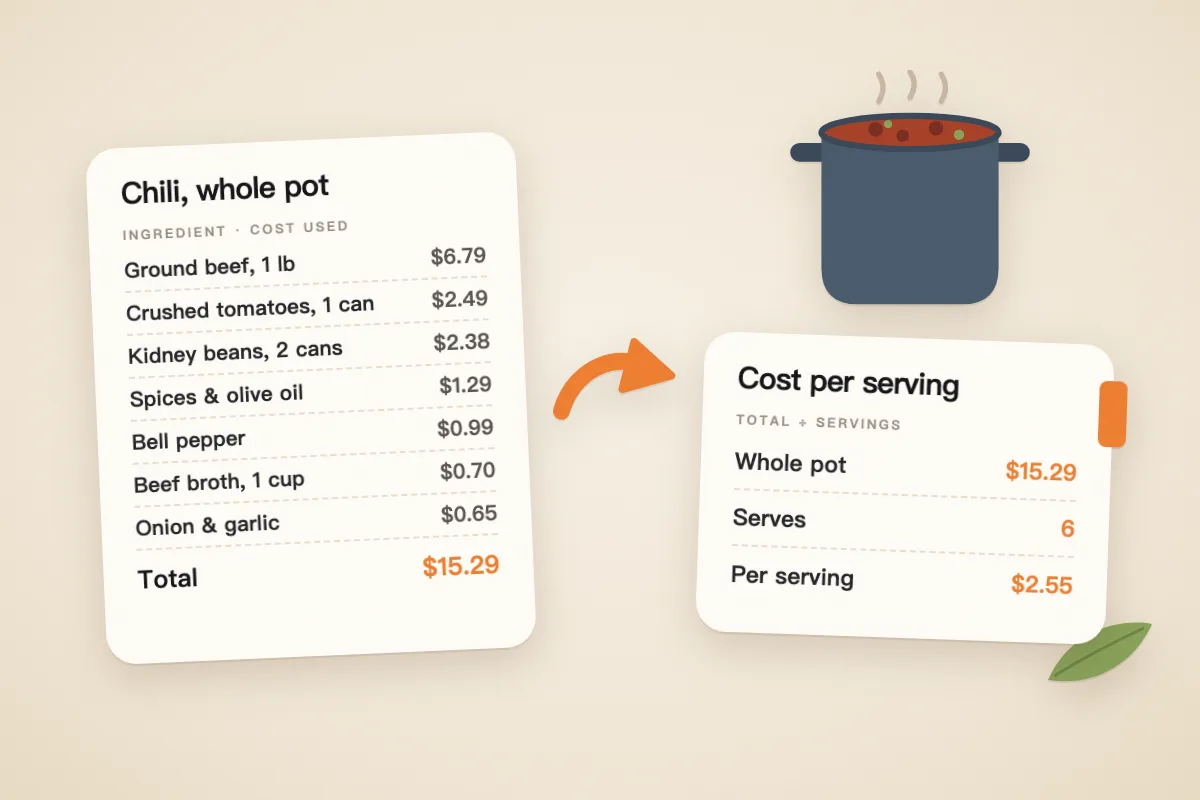
Cost per serving = cost of the ingredients you used ÷ number of servings.
- List each ingredient and how much of it went into the recipe.
- Find what you paid for the package and how much the package holds.
- Price the amount used: package price ÷ package size × amount used. Add up all the lines.
- Divide the total by the number of servings.
For the pot of chili worked through below, that’s $15.29 for the whole recipe and 6 servings: about $2.55 each.
The one idea that makes this work is pricing the amount you used rather than the package you bought. A $3.49 jar of chili powder doesn’t cost $3.49 per pot of chili when two tablespoons is all that goes in. Get that right and the rest is arithmetic.
Step 1: List what you used, and how much
Write down every ingredient with the amount that went into the recipe, in whatever unit you can match to the package: pounds, ounces, cans, cups, cloves or each. If you’re already weighing ingredients to calculate the calories in a recipe, you can reuse the same list.
Include the oil for the pan, the spices and anything you finish the dish with. Each is small, but together they add up; in the chili below, the oil and spices come to $1.29 of the total.
Step 2: Find the unit price
The unit price is what one unit of the package costs: package price ÷ package size. A 16.9 fl oz bottle of olive oil at $8.99 works out to about 53 cents per fluid ounce. Many US grocery shelf tags print a unit price next to the sale price, and your receipt or the store’s app shows what you paid.
Two details trip people up here:
- Match the units. If the jar is sold by weight (2.5 oz of chili powder) but the recipe uses tablespoons, convert one to the other first. Two tablespoons of chili powder weigh about 16 g, or 0.56 oz. Our recipe measurement conversion chart covers the common cup and spoon weights.
- Price what you bought, not the drained or trimmed weight. A can of beans is priced per can, so count cans. A head of garlic is priced per head, so divide by the number of cloves.
Step 3: Price each line and add it up
For each ingredient, cost = package price ÷ package size × amount used. For the olive oil, that’s $8.99 ÷ 16.9 fl oz × 0.5 fl oz (one tablespoon) = $0.27.
| Ingredient | Package and price | Amount used | Cost |
|---|---|---|---|
| Ground beef | 1 lb, $6.79 | 1 lb | $6.79 |
| Crushed tomatoes | 28 oz can, $2.49 | 1 can | $2.49 |
| Kidney beans | 15 oz can, $1.19 | 2 cans | $2.38 |
| Green bell pepper | $0.99 each | 1 | $0.99 |
| Chili powder | 2.5 oz jar, $3.49 | 2 tbsp (0.56 oz) | $0.79 |
| Beef broth | 32 fl oz carton, $2.79 | 1 cup (8 fl oz) | $0.70 |
| Onion | $1.29 per lb | 1 large (150 g) | $0.43 |
| Olive oil | 16.9 fl oz bottle, $8.99 | 1 tbsp (0.5 fl oz) | $0.27 |
| Ground cumin | 2 oz jar, $3.29 | 2 tsp (0.14 oz) | $0.23 |
| Garlic | $0.75 a head (about 10 cloves) | 3 cloves | $0.22 |
| Whole pot | $15.29 |
The ground beef price is the Bureau of Labor Statistics average for 100% ground beef in US cities in September 2026. The others are example prices to show the arithmetic; use your own receipt.
The beef alone is 44% of the total, and beef, tomatoes and beans together make up 76%. That pattern is common: the protein and one or two bulky ingredients decide the cost, and the spices and aromatics barely move it. If you only have time to price a few lines carefully, price those.
Step 4: Divide by servings
$15.29 ÷ 6 servings ≈ $2.55 per serving.
The number of servings matters as much as the prices. Count the portions the pot actually gives you, not the number printed on the recipe; if the same chili fills five lunch containers instead of six, each one costs about $3.06. Our guide to working out the serving size of a recipe covers weighing the finished dish and portioning it evenly.
Pantry staples, leftovers and the parts you don’t use
The formula is fixed, but a few choices are yours. Make them once and apply them the same way every time, so your costs stay comparable.
Oil, spices and salt
Price them like everything else, by the amount used. Salt and pepper rarely come to more than a few cents, so it’s fine to skip them. Spice blends and good oil are worth counting: they added $1.29 to the chili.
Ingredients you already had
Use what it would cost to replace them today, not what you paid months ago. The point of the number is to know what the dish costs to make now.
The rest of the package
If you’ll use the other half of the onion or the rest of the broth in something else, count only what went into this recipe. If it’s going to sit in the fridge until it goes off, count the whole package. That gives a more honest number for a recipe that leaves awkward leftovers.
Sale prices and bulk buys
Either use what you actually paid or a regular shelf price, but pick one approach. A recipe priced at this week’s sale price will look cheaper than it usually is.
How to bring the cost per serving down
Sort the lines by cost and start at the top. In the chili, finding the beef for 20% less saves $1.36, more than leaving out every spice and the oil ($1.29).
Swapping canned beans for dried is a good example of a change that adds up. The Nebraska Dry Bean Commission puts a 15 oz can at about 1½ cups of cooked beans, and 1 pound of dry beans at about 6 cups cooked. The two cans in the chili are 3 cups, or about half a pound of dry beans. At the BLS average of $1.67 a pound for dried beans in September 2026, that’s about $0.83 instead of $2.38. The pot drops to $13.74, or about $2.29 a serving, in exchange for soaking and simmering the beans yourself.
Other changes that move the biggest lines: a cheaper cut or a different protein, more beans and less meat, a store brand for canned tomatoes and broth, and buying staples you use often in larger packages when the unit price is lower. Check that a swap still works in the recipe before you count the savings.
If you track calories too, a swap changes both numbers; our guide to calculating calories in a recipe covers how to recount them.
App, spreadsheet or by hand?
By hand or in a spreadsheet is the most accurate, because you use your own receipts. It’s worth doing for the recipes you cook every week: price it once, save the per-serving number with the recipe, and update it when prices change.
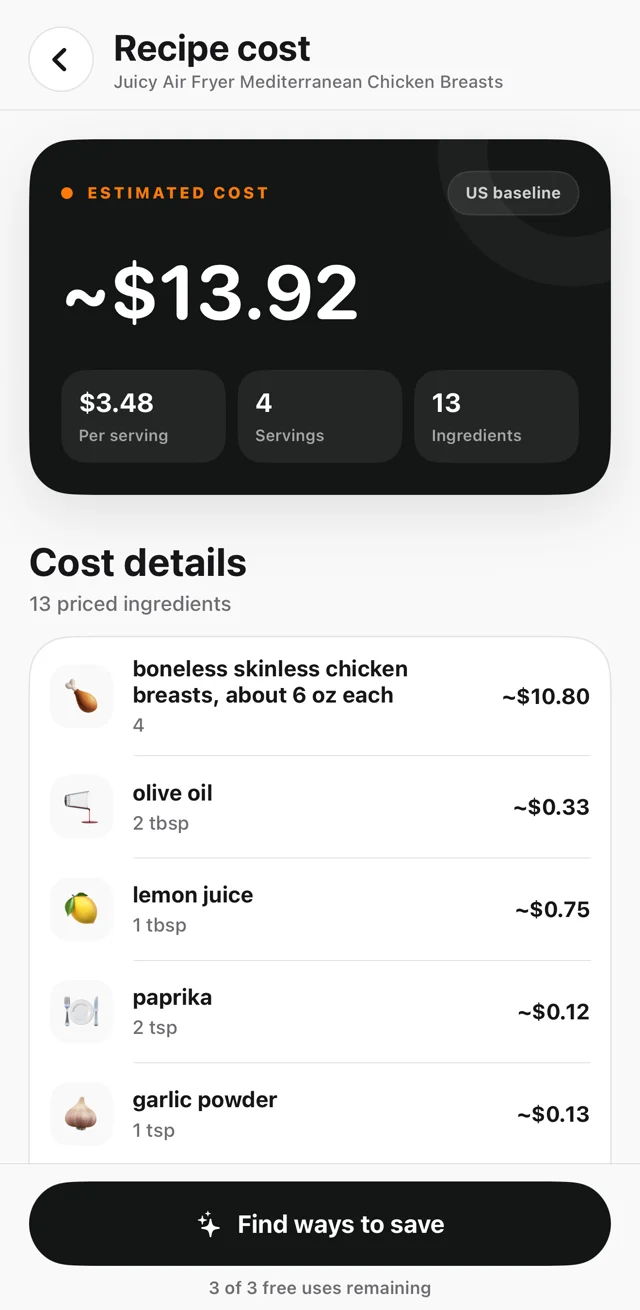
In Hireci, each saved recipe has a Recipe cost estimate: the total, the cost per serving, and a cost for each ingredient line, based on the recipe’s amounts and servings. The app labels it as an estimate from a US baseline ingredient price table, and actual prices vary by brand, store, location and season, so treat it as a quick guide rather than your receipt. Find ways to save suggests lower-cost swaps for the expensive lines. The estimate is free to view; Find ways to save includes a few free uses, then needs a Hireci+ subscription. The app is free to download for iPhone, iPad and Android.
Your cost-per-serving checklist
- Listed every ingredient with the amount used, including oil and spices.
- Found each package’s price and size, in units that match the recipe.
- Priced the amount used, not the whole package (unless the rest will go to waste).
- Added up the whole recipe before dividing.
- Divided by the servings you actually get.
- Saved the cost per serving with the recipe for next time.
Frequently asked questions
Should I include spices and oil in the cost of a recipe?
Yes, priced by the amount you used. Salt and pepper usually come to a few cents and can be skipped, but spice blends and oil can add a dollar or more to a recipe.
How do I price an ingredient I already had at home?
Use what it would cost to buy it again today. That keeps the number useful for deciding what to cook next week.
How do restaurants calculate food cost?
The same way, one ingredient line at a time, then they compare it with the menu price: food cost percentage = cost per serving ÷ menu price × 100. A dish that costs $2.55 to make and sells for $10 has a food cost of about 26%.