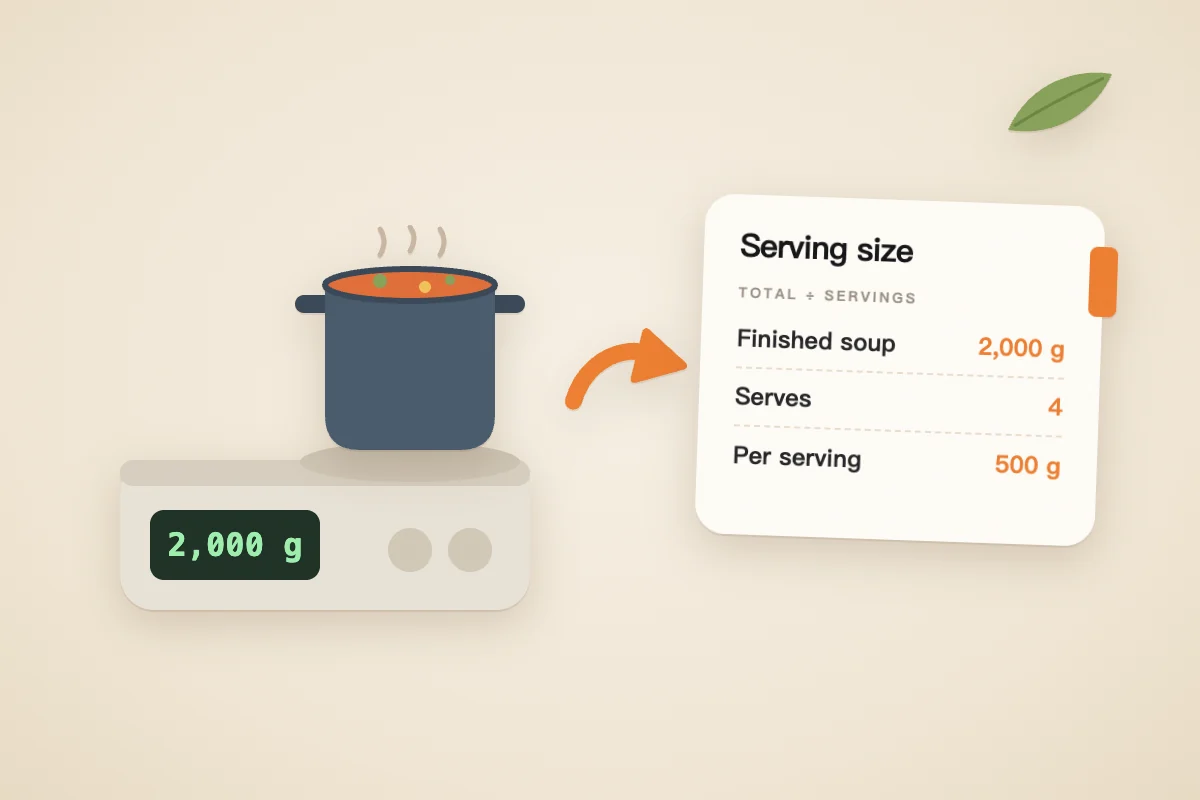
Serving size = total amount the recipe makes ÷ number of servings. Weigh the finished dish in grams (or measure it in cups, or count the pieces), then divide. A pot of soup that weighs 2,000 g and serves 4 has a 500 g serving.
The number of servings or portions a recipe makes is called its yield. It’s usually written near the title as “Serves 4” or “Makes 12.”
Working the other way round: number of servings = total amount ÷ the portion you want. 2,000 g of soup in 400 g portions makes 5 servings.
“Serves 4” tells you how many portions a recipe is meant to make, but not how big each one is. That gap matters when you’re packing lunches, logging what you eat, or deciding whether a recipe will feed six. Closing it takes a kitchen scale or a measuring cup and one line of arithmetic.
The serving size formula
| You know | You want | Calculate |
|---|---|---|
| Total amount and number of servings | Serving size | Total ÷ servings |
| Total amount and the portion you want | Number of servings | Total ÷ portion |
“Total amount” means what the finished recipe actually makes, measured after cooking. Use the same unit throughout: grams with grams, cups with cups.
Serving size calculator
Enter the weight of the finished dish. If you weighed it in its pot, add the empty pot’s weight and it’s subtracted for you.
Each serving: 500 g
Step 1: Find the recipe’s yield
The number of servings is part of the recipe’s yield: the line near the title or ingredient list that says “Serves 4,” “Makes 12 muffins” or “Yield: 6 cups.” Some recipes give both the number and the size, like “Makes 6 cups; 1½ cups per serving.” Most give only the number, so you work out the size yourself.
If you’ve changed the batch — doubled it, or halved it — use the new yield, not the original. Our guide to converting a recipe for the servings you need covers the scaling.
Step 2: Measure what the recipe makes
Weigh it: the most accurate way
- Weigh the empty pot or dish and write the number down, or put it on the scale and press tare to zero it.
- Weigh it again with the finished food in it.
- Subtract the empty weight to get the weight of the food alone.
- Divide by the number of servings.
Weigh after cooking rather than adding up the raw ingredients. Simmering cooks water off, pasta and rice absorb it, and meat loses moisture, so the finished weight can be very different from the raw total.
Measure soups, stews and sauces by volume
For anything you can ladle, volume is often easier. Ladle the finished dish into a large measuring jug, keep count, and divide by the number of servings. A US cup is about 237 mL; Australian, Canadian and New Zealand recipes use a 250 mL cup. Our recipe measurement conversion chart lists both.
Count pieces, or cut the pan evenly
For cookies, muffins, meatballs or dumplings, a serving is a number of pieces. For bars, cakes and casseroles, decide on the cut first: a 9 × 13-inch pan cut 3 rows by 4 gives 12 pieces of about 3 × 3¼ inches; cut 4 by 6 and you get 24 pieces of about 2¼ × 2 inches.
| Dish | Measured total | Servings | Serving size |
|---|---|---|---|
| Chili, weighed in a 1,450 g pot | 3,850 − 1,450 = 2,400 g | 6 | 400 g |
| Lentil soup | 8 cups | 4 | 2 cups |
| Brownies, 9 × 13 pan | 12 pieces | 6 | 2 pieces |
Per-serving nutrition, and logging what you actually ate
Nutrition per serving is the total for the whole recipe divided by the number of servings. If the servings number is wrong, every per-serving figure is wrong with it: a recipe that really makes 8 servings but is recorded as 1 shows eight times the calories per serving.
Real portions are rarely exact, so for tracking it’s more accurate to work from weight:
- Weigh the whole finished dish, say 2,400 g.
- Weigh what’s on your plate, say 300 g.
- Your share is 300 ÷ 2,400 = ⅛ of the recipe.
- Multiply the recipe’s total nutrition by that share. If the whole pot is 3,200 kcal, your plate is 3,200 × ⅛ = 400 kcal.
These numbers illustrate the method; use your own recipe’s totals. The same logic works for protein, carbs or anything else you track. To get the recipe’s total in the first place, see how to calculate calories in a recipe.
When the recipe doesn’t say how many it serves
Recipes from videos, family cards and screenshots often skip the yield. Work backwards instead:
- Use the portion you actually eat. Weigh a typical plate, then divide the finished total by that weight. 2,400 g of chili in 400 g plates is 6 servings.
- Compare with a similar recipe. Find a written recipe for the same dish with a stated yield and compare the main ingredient: if it uses 500 g of pasta to serve 4 and yours uses 1 kg, yours probably serves about 8.
- Write it down. A yield you chose yourself is still useful, as long as it’s recorded with the recipe.
Serving sizes on a packaged food’s Nutrition Facts label are a different thing. The FDA explains that a label’s serving size reflects the amount people typically eat or drink and is not a recommendation of how much you should eat. Your recipe’s serving size can be whatever portion works for you, as long as you use it consistently.
If the recipe also skips the ingredient amounts, sort those out first; our guide to recipe videos with no measurements covers filling the gaps.
Portion a batch for meal prep
For meal prep, the containers decide the servings. Weigh the finished batch, decide how many containers you’re filling, and divide: 2,400 g of chili across 5 lunch containers is 480 g each. Put an empty container on the scale, tare it, and fill each one to that weight so every lunch is the same.
Write the number of containers back into the recipe as its yield. Next time, you’ll know in advance how many lunches one batch makes.
Keep the serving size with the recipe in Hireci
Hireci shows a nutrition estimate per serving for each recipe, so the servings number matters. When a recipe doesn’t state its yield, Hireci estimates one and labels the nutrition Estimated per serving with the number of servings it assumed. If that doesn’t match what you make, change the servings on the recipe; the next time you open its nutrition, it’s worked out again for the new yield.
To record the serving size itself, open the recipe, tap the … menu, choose Edit recipe, and add it to the notes, such as “Makes 2,400 g · 400 g per serving.” Some features, including nutrition analysis, need a Hireci+ subscription; the app itself is free to download.
Your serving-size checklist
- Found the recipe’s yield, or decided on one.
- Weighed, measured or counted the finished dish, not the raw ingredients.
- Divided the total by the number of servings.
- Recorded the serving size with the recipe.
- Checked the servings number before trusting per-serving nutrition.
Frequently asked questions
How do I calculate the serving size of a recipe?
Weigh or measure the total amount the recipe makes after cooking, then divide by the number of servings. For example, 2,400 g of chili divided by 6 servings is 400 g per serving.
How do I work out how many servings a recipe makes?
Divide the total amount by the portion you want. 2,000 g of soup in 400 g portions makes 5 servings.
Which part of a recipe tells the number of servings?
The yield: the number of servings or portions a recipe makes. It’s usually shown near the title or ingredient list as “Serves 4,” “Makes 12” or “Yield: 6 cups.” When it doesn’t give the size of each serving, calculate it from the finished dish.
Should I weigh food before or after cooking to find serving size?
After cooking. Liquids evaporate, pasta and rice absorb water, and meat loses moisture, so the raw weight can be very different from what you serve.
How do I calculate calories per serving of a homemade recipe?
Add up the nutrition for the whole recipe and divide by the number of servings. For a portion you weighed, divide your portion’s weight by the finished dish’s weight and multiply the recipe’s total by that share. Our guide to calculating calories in a recipe shows how to add up the total.
How many servings are in a 9 × 13 pan?
It depends on the cut. Three rows by four gives 12 pieces of about 3 × 3¼ inches; four rows by six gives 24 pieces of about 2¼ × 2 inches.