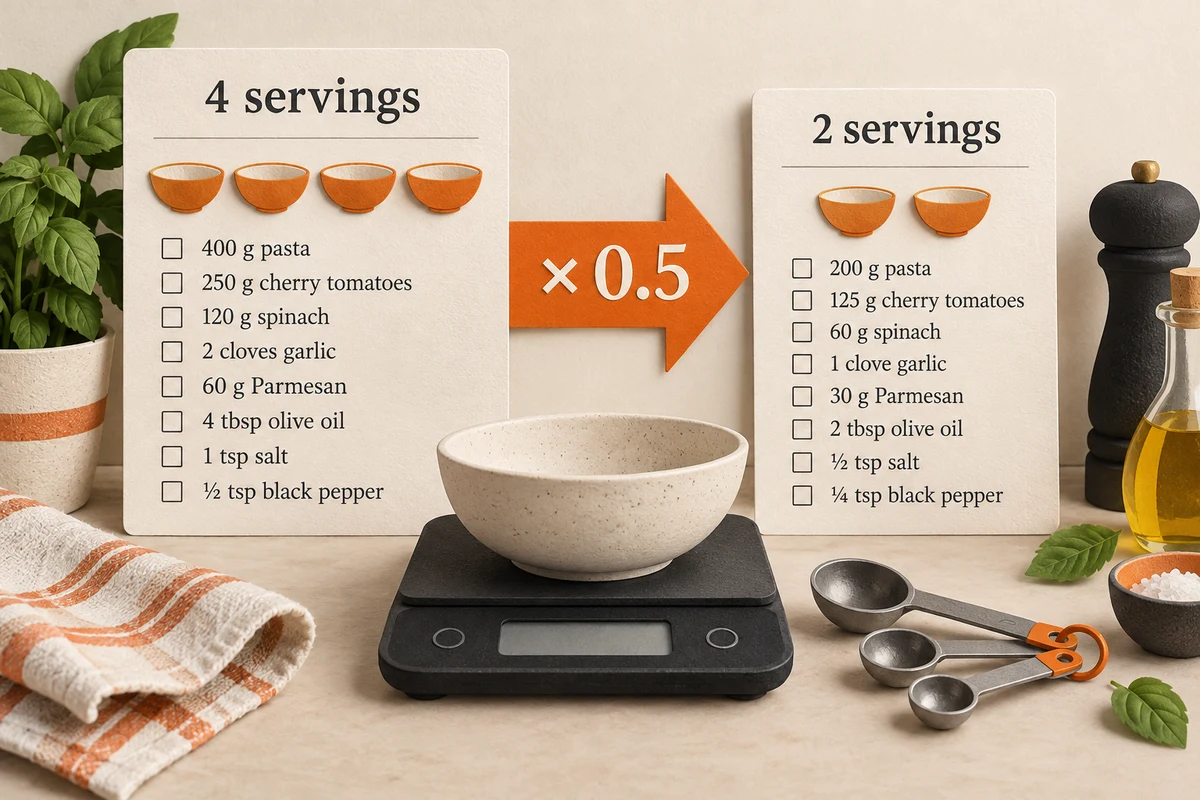
To convert a recipe to a different number of servings, divide the servings you want by the original servings. Multiply each measured ingredient amount by that number. Going from six servings to two? Your factor is 2 ÷ 6 = ⅓. Use one-third of each measured ingredient, but don’t divide the oven temperature or cooking time by three.
“Convert” can also mean changing cups to grams, or turning an online cooking video into a written recipe. Those are separate jobs. This guide starts with serving sizes, then covers measurement changes. If your recipe is still inside a video, jump to getting a usable copy first.
Find your recipe conversion factor
Start with the original yield. “Serves 4” and “makes 12 muffins” both work, as long as the new yield uses the same kind of portion. Six large muffins aren’t necessarily half the batter of twelve small ones.
Original ingredient amount × factor = new amount
This is the yield-conversion method used in Maine’s culinary recipe-conversion lesson. Write the factor at the top of your working copy before changing any quantities.
| Original yield | New yield | Multiply by |
|---|---|---|
| 4 servings | 2 servings | 0.5 |
| 4 servings | 6 servings | 1.5 |
| 6 servings | 2 servings | ⅓ |
| 6 servings | 8 servings | 1⅓ |
| 12 cookies | 24 cookies of the same size | 2 |
If the recipe has already been doubled on a website, use the yield attached to the amounts you’re looking at. Dividing a doubled ingredient list by the original serving count gives you the wrong starting point.
A worked example: four servings to six
Suppose your ingredient list includes the amounts below. You want six servings instead of four, so the factor is 6 ÷ 4 = 1.5. This is a math example, not a tested dish.
| Ingredient | For 4 | Calculation | For 6 |
|---|---|---|---|
| Dry pasta | 320 g | 320 × 1.5 | 480 g |
| Chopped tomatoes | 400 g | 400 × 1.5 | 600 g |
| Olive oil | 2 tbsp | 2 × 1.5 | 3 tbsp |
| Grated cheese | 60 g | 60 × 1.5 | 90 g |
| Chili flakes | ¼ tsp | ¼ × 1.5 | ⅜ tsp |
That last line is the sort of number that makes people pause. You can measure ⅜ teaspoon as ¼ teaspoon plus ⅛ teaspoon. For this adjustable seasoning, you could also start with the smaller amount and decide whether you want more. Don’t apply that same casual rounding to every small quantity in a baking recipe.
Now read the directions. If they say “add half the cheese,” half means 45 g from your new 90 g total. If they say “reserve 20 g of the cheese,” that written amount also needs reviewing: the proportional amount would be 30 g. Changing only the ingredient list can leave contradictory instructions behind.
Keep fractions intact until you finish the calculation. For example, a third of 300 g is exactly 100 g; multiplying by a rounded 0.33 gives 99 g. The difference is small here, but there’s no benefit to introducing it.
Convert measurements without changing the recipe twice
Scaling changes how much food you make. Unit conversion changes how you measure the same amount. Work through them separately so you can see which number changed and why.
Use smaller spoons when fractions get awkward
For US kitchen measures, 1 tablespoon equals 3 teaspoons and 1 cup equals 16 tablespoons. These relationships are listed in NIST’s household measurement chart. They make small batches easier to measure:
- Half of 1 tablespoon is 1½ teaspoons.
- Half of ¼ cup is 2 tablespoons.
- One-third of 1 tablespoon is 1 teaspoon.
Check the measurement system when using a recipe from another country. A measuring cup isn’t universally the same volume. Use the author’s stated units rather than treating every “cup” as interchangeable.
Cups to grams depend on the ingredient
A cup measures volume; a gram measures mass. There isn’t one cups-to-grams multiplier that works for flour, honey and chopped vegetables alike. Prefer the weights supplied by the recipe author. If none are given, use an ingredient-specific reference such as King Arthur Baking’s ingredient weight chart, matching the ingredient and preparation as closely as possible.
For example, that chart lists a cup of all-purpose flour as 120 g. On that basis, 1½ cups is 180 g, and half of that amount is 90 g. Those numbers are useful for that flour measurement; they do not mean a cup of every ingredient weighs 120 g.
The ingredient math is only part of the job
Half a batch does not mean half the baking time
Keep the recipe’s oven temperature as your starting point when changing yield. Baking time depends on the size and depth of what’s in the oven. Six cookies of the original size won’t necessarily bake in half the time of twelve.
For cakes and bars, choose a pan that keeps the batter depth close to the original. Half the batter in the same wide pan makes a thinner layer. King Arthur’s guide to reducing recipes explains how pan area, baking time and partial eggs affect a smaller batch.
Measure a partial egg instead of guessing
If a reduced recipe needs half an egg, beat the whole egg until the yolk and white are combined, weigh it without the shell, and use half that weight. A recipe calling for separate whites or yolks needs those components handled separately. Don’t swap in an extra whole egg just to avoid the fraction.
Read the equipment instructions again
Before making a larger batch, ask where it will go. Does the mixture fit in your bowl? Can the food sit in the pan as the recipe describes? Would two batches let you follow the original method more closely? The arithmetic can be correct while the cooking setup is wrong.
Also flag instructions such as “water to cover” or “oil for the pan.” These describe a condition or a piece of equipment, not a fixed ingredient quantity. They need a fresh look after the batch size changes.
Keep a recipe copy you can actually use
When you’ve finished the conversion, label the new yield clearly. Keep the original version or source link, and note any deliberate departures from the calculation. “Chili reduced to ¼ tsp” is more useful next week than trying to remember whether ¼ teaspoon was the original amount.
If your starting point is a food blog, our guide to saving recipes from websites explains how to bring a supported recipe into Hireci and check the imported amounts against the source. Confirm that the yield and ingredient list belong to the same version before doing any scaling.
For a cooking video, collect the written ingredients and directions first. The Instagram Recipe Converter tutorial and TikTok Recipe Converter tutorial cover that workflow. Importing a post and resizing its recipe are different steps; neither fixes missing quantities by itself.
One last pass before cooking
- The new yield is written down.
- Every measured ingredient uses the same factor.
- Amounts repeated in the directions have been checked.
- Partial eggs and awkward fractions have a measurement plan.
- The pan, batch size and cooking checks still make sense.
Once those details agree, you can put the calculator away and cook from one clean set of instructions.