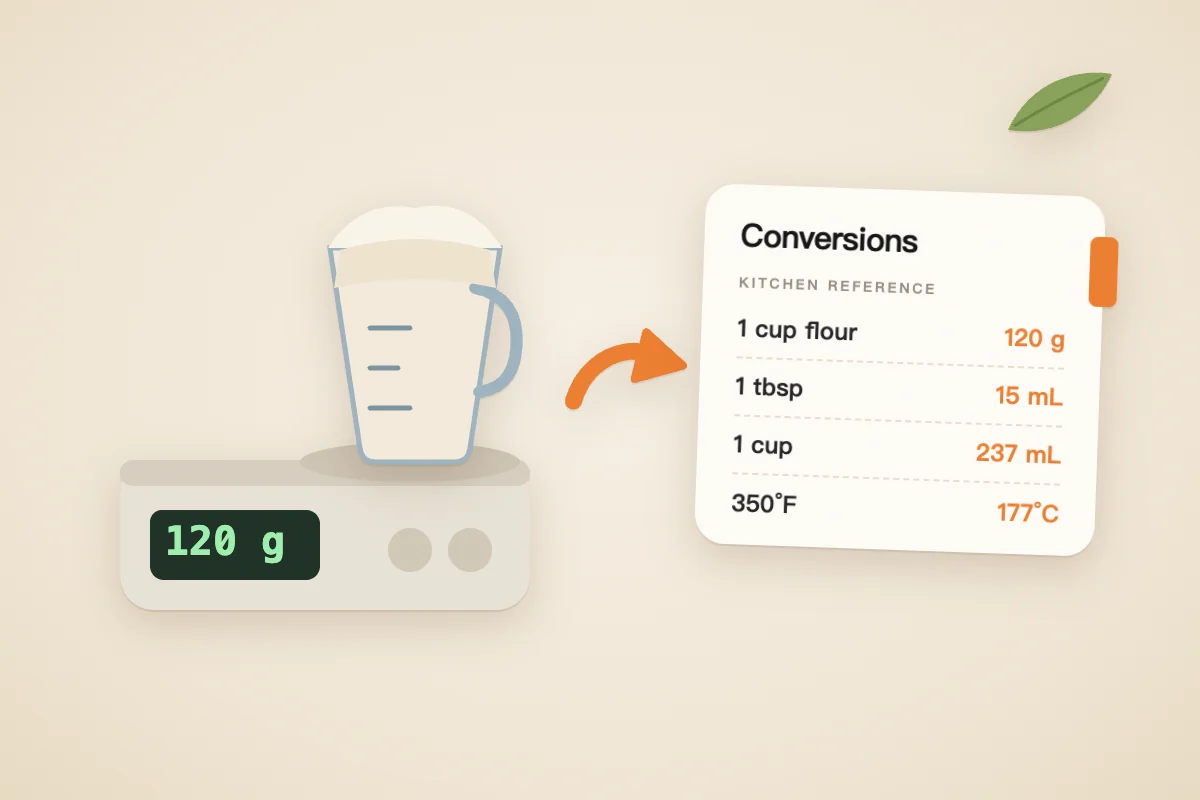
Converting a recipe measurement depends on what you’re converting. Volume to volume — cups and spoons to milliliters — uses fixed numbers: a US cup is about 237 mL and a tablespoon about 15 mL. Volume to weight — cups to grams — depends on the ingredient: a cup of all-purpose flour is about 120 g, but a cup of sugar is about 198 g. Oven temperatures follow a formula. The charts below cover all three.
This page is a reference: find the row you need and go back to cooking. If you’re changing how many people a recipe serves rather than its units, start with our guide to converting a recipe for the servings you need, then come back here for the units.
Cups and spoons to milliliters
US volume measures convert to milliliters with fixed numbers. These come from the National Institute of Standards and Technology’s household measurement chart, rounded as NIST rounds them.
| US measure | Equals | Milliliters |
|---|---|---|
| 1 teaspoon | — | 4.9 mL |
| 1 tablespoon | 3 teaspoons | 15 mL |
| 1 fluid ounce | 2 tablespoons | 30 mL |
| ¼ cup | 4 tablespoons | 59 mL |
| ½ cup | 8 tablespoons | 118 mL |
| 1 cup | 16 tablespoons or 48 teaspoons | 237 mL |
Before you convert, check where the recipe comes from. A “cup” isn’t the same everywhere: Australia, Canada and New Zealand use a metric cup of 250 mL, and US nutrition labels round a cup to 240 mL. The Australian tablespoon is 20 mL rather than 15. For most cooking the difference won’t matter, but in baking or with strong ingredients like salt, use the measures of the country the recipe was written in.
Cups to grams for common ingredients
A cup measures volume and a gram measures mass, so there’s no single number that converts every ingredient. The weights below come from King Arthur Baking’s ingredient weight chart, which is built for baking and notes that its figures are rounded. Volumes are shown as King Arthur lists them; some rows are for half a cup or a spoon rather than a full cup.
| Ingredient | Volume | Grams |
|---|---|---|
| All-purpose flour | 1 cup | 120 g |
| Bread flour | 1 cup | 120 g |
| Cake flour | 1 cup | 120 g |
| Whole wheat flour | 1 cup | 113 g |
| Almond flour | 1 cup | 96 g |
| Rolled oats (old-fashioned or quick) | 1 cup | 89 g |
| Long-grain rice, dry | ½ cup | 99 g |
| Unsweetened cocoa | ½ cup | 42 g |
| Cornstarch | ¼ cup | 28 g |
| Ingredient | Volume | Grams |
|---|---|---|
| Granulated sugar | 1 cup | 198 g |
| Brown sugar, packed | 1 cup | 213 g |
| Confectioners’ sugar, unsifted | 1 cup | 113 g |
| Honey | 1 tablespoon | 21 g |
| Maple syrup | ½ cup | 156 g |
| Ingredient | Volume | Grams |
|---|---|---|
| Butter | 8 tablespoons (½ cup) | 113 g |
| Vegetable oil | 1 cup | 198 g |
| Milk | 1 cup | 227 g |
| Heavy cream, light cream or half-and-half | 1 cup | 227 g |
| Sour cream | 1 cup | 227 g |
| Yogurt | 1 cup | 227 g |
| Water | 1 cup | 227 g |
| Peanut butter | ½ cup | 135 g |
| Grated cheddar, jack, mozzarella or Swiss | 1 cup | 113 g |
| Grated Parmesan | ½ cup | 50 g |
| Ingredient | Volume | Grams |
|---|---|---|
| Chocolate chips | 1 cup | 170 g |
| Walnuts, chopped | 1 cup | 113 g |
| Egg, without shell | 1 large | 50 g |
| Baking powder | 1 teaspoon | 4 g |
| Baking soda | ½ teaspoon | 3 g |
| Table salt | 1 tablespoon | 18 g |
| Kosher salt, Diamond Crystal | 1 tablespoon | 8 g |
| Kosher salt, Morton | 1 tablespoon | 16 g |
To convert a different amount, scale the row. Two cups of all-purpose flour are 2 × 120 = 240 g; a quarter cup of sugar is 198 ÷ 4, about 50 g. If the recipe author gives weights, use theirs instead: they measured the way their recipe expects.
Why a cup weighs different amounts
The same cup holds very different weights depending on what’s in it and how it got there.
- Flour compacts. Scooping straight from the bag packs in far more than spooning it in and leveling it. That’s why King Arthur Baking recommends a scale for flour and bases its recipes on 120 g per cup.
- Some recipes say “packed” on purpose. Brown sugar is pressed into the cup, which is why its cup weighs more than granulated sugar’s.
- Salt crystals differ by brand. A tablespoon of Diamond Crystal kosher salt weighs half as much as the same spoon of Morton, so a recipe that only says “kosher salt” can be twice as salty with the wrong box.
- Charts round. A US cup holds about 237 mL, yet the chart lists a cup of water as 227 g — 8 ounces, a convenient baking figure. For water and milk, either number works in everyday cooking.
When a conversion really matters — bread, cakes, pastry — weigh the ingredient once in the units the recipe uses, and keep that weight.
Oven temperatures: Fahrenheit to Celsius
To convert Fahrenheit to Celsius, subtract 32 and multiply by 5/9. To go the other way, multiply Celsius by 9/5 and add 32. Metric recipes usually round to a tidy number, so 350°F often appears as 180°C rather than 177°C.
| Fahrenheit | Celsius (exact) | Often written as |
|---|---|---|
| 325°F | 163°C | 160–165°C |
| 350°F | 177°C | 180°C |
| 375°F | 191°C | 190°C |
| 400°F | 204°C | 200°C |
| 425°F | 218°C | 220°C |
| 450°F | 232°C | 230°C |
If a recipe says “fan” or “convection,” it already assumes a fan oven. Follow the oven type the recipe names, and check the first batch a few minutes early.
Use converted amounts well
Converting is error-prone when you do it at the stove. Do it once, carefully, and keep the result.
- Convert the whole recipe, not one ingredient. Mixing cups for some ingredients and grams for others is how mistakes slip in.
- Keep the original amounts nearby. If something tastes off, you’ll want to check your conversion against the source.
- Round sensibly. 113 g of butter can be 115 g; 4 g of baking powder should stay 4 g.
- Change servings separately. Converting units and scaling servings are two different steps. Do one, check it, then do the other.
Once you’ve converted a recipe you cook often, save the new amounts with it. In Hireci, open the recipe, tap the … menu, choose Edit recipe, update each amount, and note the original units in the recipe’s notes before you tap Save. If the recipe came from a video that never gave amounts at all, our guide to recipe videos with no measurements covers how to fill those gaps first.
Your conversion checklist
- Checked which country’s cups and spoons the recipe uses.
- Converted volumes with fixed numbers and weights by ingredient.
- Used the author’s own weights when they were given.
- Weighed flour for baking rather than scooping.
- Matched the salt brand, or converted by weight.
- Converted the oven temperature and noted the oven type.
- Saved the converted recipe so you only do it once.
Frequently asked questions
How many grams are in a cup of flour?
King Arthur Baking lists a cup of all-purpose flour as 120 grams, and the same for bread flour and cake flour. Whole wheat flour is lighter at 113 grams. A scooped cup can weigh noticeably more, so weigh flour when accuracy matters.
How many milliliters are in a cup?
A US cup is about 237 mL according to NIST. Australia, Canada and New Zealand use a metric cup of 250 mL, and US nutrition labels round a cup to 240 mL. Use the cup size of the country the recipe comes from.
How many grams of butter are in a tablespoon?
About 14 grams. King Arthur Baking lists 8 tablespoons, or half a cup, of butter as 113 grams, which works out to roughly 14 grams per tablespoon.
What is 350°F in Celsius?
350°F is about 177°C. Metric recipes usually round it to 180°C. To convert any Fahrenheit temperature, subtract 32 and multiply by 5/9.