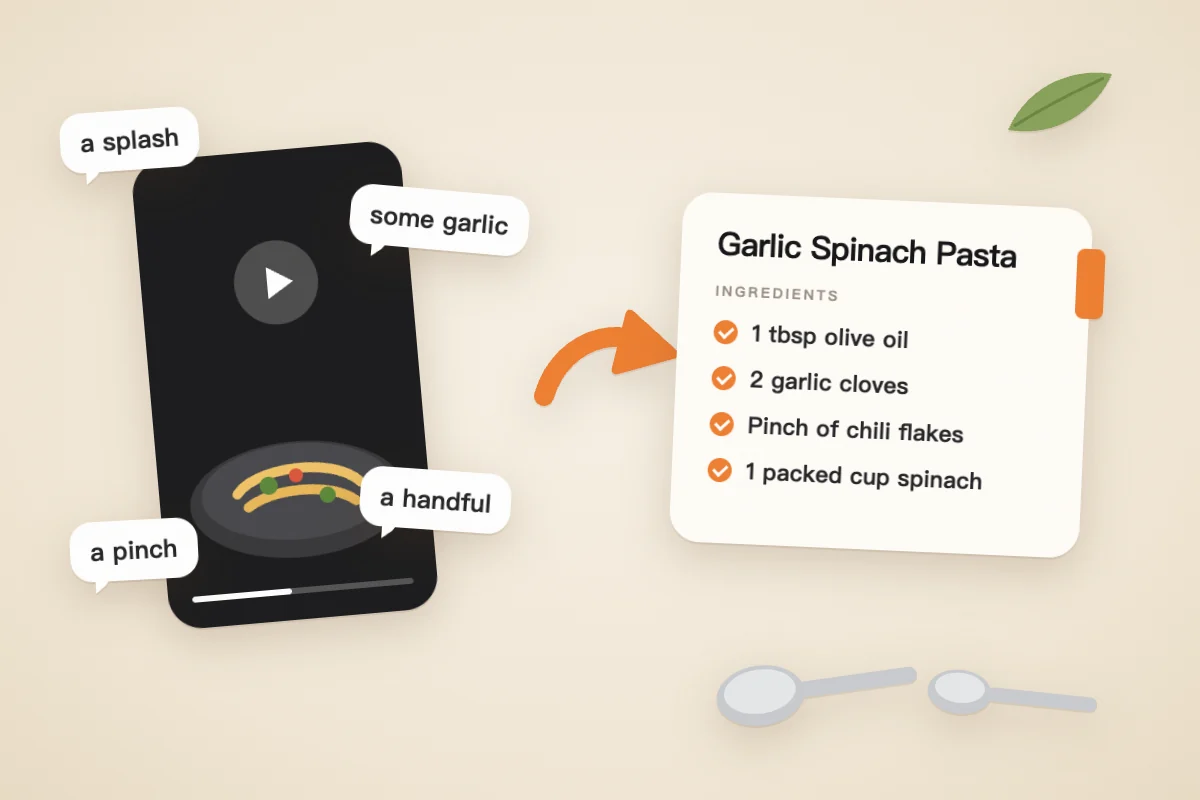
When a recipe video doesn’t give measurements, look for them in writing first — the caption, the pinned comment, the creator’s linked recipe or the text on screen. If they aren’t there, estimate forgiving ingredients like oil, garlic and greens from what you can see, keep tiny amounts like a pinch as they are, and don’t guess the ones that decide whether a dish works: flour and leavening in baking, and the doneness of meat. Then write down what you actually used, so the second time is easy.
Plenty of cooking videos are made to be watched, not followed. The creator knows how much oil “a splash” is because they’ve made the dish fifty times. You haven’t, and pausing the video every ten seconds to squint at the pan isn’t cooking. The good news is that most dishes in short videos are forgiving, and the few things that aren’t are easy to spot.
Look for the written recipe first
Before you estimate anything, check whether the amounts exist somewhere other than the voiceover. Creators often keep them out of the video to keep it short.
- The caption. Tap more on the caption. Many creators paste the full ingredient list there, below the hashtags.
- The pinned comment. If viewers asked “how much?”, the creator may have answered once and pinned it.
- The creator’s link. A link in the bio or description often leads to a blog post with the written recipe.
- The screen itself. Pause on the ingredient shots. Text overlays often flash past — “200 g pasta,” “2 tbsp butter” — faster than you can read at full speed.
On YouTube, the description box is the first place to look; our guide to turning a YouTube Short into a recipe covers descriptions and timestamps in detail.
When you import the video into Hireci, the recipe is built from the text the post provides, so any amounts in the caption or description come along. If the creator never wrote the amounts down, the imported recipe will list the ingredients without them. That’s expected: an import can organize what’s there, but it can’t know how much garlic went in if nobody said. The platform guides for TikTok and Instagram show what an import usually brings in.
Estimate from what you can see
For everything still missing, the video itself has more information than it seems. Watch it once through without cooking, and note these clues:
- How many people it feeds. A dish served onto two plates tells you the scale. A large sheet pan or a pot of pasta for a family points the other way.
- Countable things. Garlic cloves, eggs, onions, chicken thighs and cans are easy to count on screen. Count them instead of guessing.
- The container. A familiar can, a stick of butter or a supermarket tub gives you a size reference for everything next to it.
- The spoon. If the creator scoops with a spoon, count the scoops and note whether they look level or heaped.
For pours, calibrate yourself once. Pour olive oil from your own bottle into a tablespoon and notice roughly how long it takes. After that, a two-second pour in a video means something to you. It won’t match the creator’s bottle exactly, but it turns “a splash” into a range you can taste your way through.
Decode the vague phrases
Most short-video recipes lean on the same handful of phrases. None of them has an official definition, so treat the starting points below as places to begin tasting, not conversions.
| In the video | A sensible start | How to adjust |
|---|---|---|
| A splash (oil, vinegar, sauce) | About 1 tablespoon | Taste, then add more in small amounts. |
| A drizzle | 1–2 teaspoons | It’s a finishing touch; add until it looks glossy. |
| A knob of butter | About 1 tablespoon | More for a rich sauce, less for greasing a pan. |
| A pinch or a dash | Keep it as written | Tiny on purpose; season again at the end. |
| A handful (greens, herbs, cheese) | A loosely packed cup | Greens wilt down a lot, so add more if the pan looks empty. |
| Salt to taste | Start small and taste | Add in stages; you can’t take salt back out. |
Some measuring-spoon sets sold since the early 2000s label a dash as ⅛ teaspoon and a pinch as 1/16 teaspoon, but traditional cookbooks never agreed on these, and neither do video creators. For a pinch, what matters is that it’s small; you’ll season again at the end anyway.
If you’re unsure where to start with an ingredient, you can also ask Hireci’s AI Recipe Assistant for a typical starting amount. Treat its answer the way you’d treat the table above: a first guess you confirm by tasting.
When not to guess
A stir-fry, a pasta sauce or a marinade will forgive you. A few things won’t, and for those it’s worth finding a written recipe or stopping to check.
Flour and leavening in baking. Baking depends on ratios. Even a measured cup of flour varies with how tightly it’s packed, which is why King Arthur Baking recommends a scale and assumes 120 grams per cup in its recipes. If a baking video gives no amounts for flour, sugar, butter or baking powder, find a written recipe for the same bake and use the video only for technique.
Salt, when the amount is specific. “Salt to taste” is safe to estimate. A specific amount of kosher salt is not, because brands differ: America’s Test Kitchen found that a teaspoon of Diamond Crystal weighs about 3 grams and a teaspoon of Morton about 5. If the video mentions a brand, note it.
“Cook until done.” Timing in a short video is often edited out, and a creator’s stove isn’t yours. For meat, poultry and fish, use a thermometer rather than the clock. The U.S. government’s safe minimum internal temperatures are 165°F (74°C) for poultry, 160°F (71°C) for ground meat, and 145°F (63°C) for fish and for beef or pork steaks and chops, which also need a 3-minute rest.
Anything preserved. Canning, curing and fermenting videos are not the place to improvise amounts or times. Follow a tested written recipe.
Save the amounts that worked
The first time you cook from a video without measurements, you’re doing the creator’s job: turning a performance into a recipe. Don’t throw that work away. Right after cooking, while you still remember, write down what you actually used.
In Hireci, open the recipe, tap the … menu, choose Edit recipe, and type the amounts into each ingredient. If an amount is still a guess, say so in the recipe’s notes (“oil: about 2 tbsp, taste next time”) so future you knows which numbers are tested. Add anything the video skipped, like the size of the pan you used, then tap Save.
Once the amounts are written down, the recipe becomes something you can scale for more people, add to a grocery list, or send to a friend. If you need to double it, our guide to converting a recipe for more servings walks through the math.
Your no-measurements checklist
- Caption, pinned comment, creator link and on-screen text all checked.
- Countable ingredients counted, not guessed.
- Forgiving amounts estimated and tasted as you went.
- Pinches and “to taste” left small, with seasoning checked at the end.
- Baking amounts taken from a written recipe, not the video.
- Meat and fish checked with a thermometer.
- What you actually used saved in the recipe.
Frequently asked questions
How much is a splash in a recipe?
There is no standard amount. For oil, vinegar or sauce, about a tablespoon is a sensible place to start. Taste, then add more in small amounts, and write down what you ended up using.
How much is a pinch of salt?
A pinch is simply a very small amount, roughly what you can hold between your thumb and finger. Some measuring-spoon sets define it as 1/16 teaspoon, but traditional cookbooks never agreed on one value. Season again at the end rather than worrying about the exact size.
Can I bake from a video that has no measurements?
Use the video for technique, but take the amounts from a written recipe for the same bake. Baking depends on the ratio of flour, fat, sugar and leavening, and small guesses can change the result a lot.
Why doesn’t my imported recipe have amounts?
An import organizes the details the post provides, such as the caption or description. If the creator never wrote the amounts down, they can’t appear in the recipe. Check the comments and the creator’s link, then add the amounts yourself with Edit recipe after you’ve cooked it.