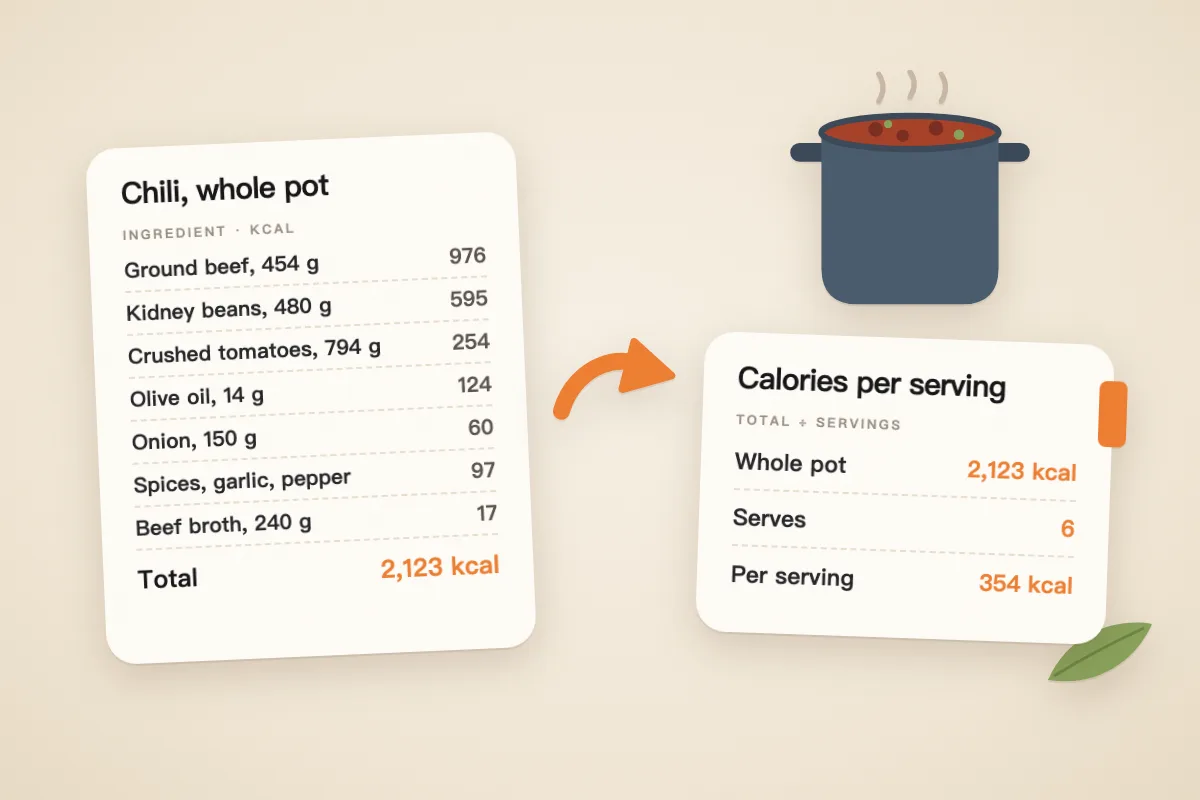
Calories per serving = calories in every ingredient you used ÷ number of servings.
- Write down each ingredient’s weight in grams.
- Look up its calories per 100 g.
- Multiply: grams × calories per 100 g ÷ 100. Add up all the lines.
- Divide the total by the number of servings.
For the pot of chili worked through below, that’s 2,123 kcal in total and 6 servings: about 354 kcal each.
Any recipe calorie calculator does exactly this, one line at a time. Doing it once by hand shows you which lines matter. In most savory recipes, a few ingredients (meat, oil, cheese, beans, pasta) carry nearly all the calories, and the vegetables and spices barely move the total.
Step 1: Write down every ingredient by weight
Grams make the rest of the job simple, because nutrition databases list calories per 100 g. Cups don’t: a cup of flour weighs about 120 g, while a cup of sugar weighs closer to 200 g. If the recipe only gives cups and spoons, our cups-to-grams chart for common ingredients covers the usual ones, but weighing as you cook is more accurate. Put the bowl or pan on the scale, press tare to zero it, add the ingredient, write down the number, and tare again before the next one.
Write down everything that ends up in the food:
- Fat for the pan. The tablespoon of oil you start the onions in can outweigh all the vegetables in the pot.
- “To taste” and finishing touches. Salt and pepper don’t matter, but the honey you stirred in, the cheese on top and the swirl of sour cream do.
- Canned and packaged foods as you used them. Drained beans, not the whole can. Note which you did, because the database entries differ.
You can skip things you take out before eating, like a bay leaf or a cinnamon stick. If the recipe came from a video that never gave amounts, settle those first; our guide to recipe videos with no measurements covers how.
Step 2: Look up calories per 100 g
For whole ingredients, use USDA FoodData Central, the U.S. Department of Agriculture’s free food composition database. Search for the food, open the entry, and read the energy value in kcal per 100 g. For packaged foods, the label is usually more accurate than a generic entry. Labels give calories per serving, so divide by the serving’s weight in grams and multiply by 100.
Then check that the entry matches the food as you weighed it. Raw and cooked versions of the same food have very different numbers, because cooking adds or removes water:
| Food | As weighed | kcal per 100 g |
|---|---|---|
| Pasta | Dry | 371 |
| Cooked | 158 | |
| Ground beef, 85% lean | Raw | 215 |
| Cooked, pan-browned | 256 |
Weigh pasta dry and use the cooked entry, and you’ll count less than half its calories. For a recipe, the raw or dry weight is usually easier, since that’s what you measure before cooking. Choose the entry that matches.
Pick the closest variety too. Ground beef runs from 70% to 95% lean, and the fat makes a large difference, so the number on the package is worth matching.
Step 3: Multiply and add it up
For each ingredient, calories = grams × kcal per 100 g ÷ 100. The ground beef below is 454 × 215 ÷ 100 = 976 kcal. Do that for every line and add them up.
| Ingredient | Amount | Grams | kcal per 100 g | kcal |
|---|---|---|---|---|
| Ground beef, 85% lean, raw | 1 lb | 454 | 215 | 976 |
| Kidney beans, canned, drained | 2 cans (15 oz) | 480 | 124 | 595 |
| Crushed tomatoes, canned | 1 can (28 oz) | 794 | 32 | 254 |
| Olive oil | 1 tbsp | 14 | 884 | 124 |
| Onion | 1 large | 150 | 40 | 60 |
| Chili powder | 2 tbsp | 16 | 282 | 45 |
| Green bell pepper | 1 medium | 120 | 20 | 24 |
| Beef broth | 1 cup | 240 | 7 | 17 |
| Ground cumin | 2 tsp | 4 | 375 | 15 |
| Garlic | 3 cloves | 9 | 149 | 13 |
| Whole pot | 2,281 | 2,123 |
The beef, beans and tomatoes make up 86% of the total, and the tablespoon of oil adds more than the onion, pepper and garlic combined. That’s the usual pattern, and it tells you where to be careful: weigh the high-calorie ingredients exactly, and don’t worry about a few grams of onion.
Protein, carbs and fat work the same way
Each USDA entry also lists protein, fat and carbohydrate per 100 g. Run the same multiplication for each and the chili comes to about 145 g protein, 93 g fat and 193 g carbohydrate for the pot, or 24 g, 16 g and 32 g per serving. That’s all a recipe macro calculator is doing.
If you check the calories against the macros (4 kcal per gram of protein and carbohydrate, 9 per gram of fat), you get about 2,190 kcal rather than 2,123. Small gaps like that are normal: USDA calculates each food’s energy with factors specific to that food rather than the rounded 4-9-4.
Step 4: Divide by servings, or by weight
If everyone gets an equal share, divide: 2,123 kcal ÷ 6 servings ≈ 354 kcal per serving.
Real bowls are rarely equal, so for logging what you actually ate, work from weight instead:
- Weigh the finished chili without the pot. Say it comes to 2,000 g after simmering.
- Divide the calories by the weight: 2,123 ÷ 2,000 ≈ 1.06 kcal per gram.
- Weigh your bowl, say 400 g, and multiply: 400 × 2,123 ÷ 2,000 ≈ 425 kcal.
Use the finished weight, not the raw ingredients added up. Simmering cooks off water, so the pot weighs less than what went into it while the calories stay put. Our guide to weighing the finished dish to find your serving size covers taring the pot and portioning a batch.
Where recipe calorie counts usually go wrong
Most errors come from something that didn’t make it into the bowl, or something that did but never got written down.
Oil for frying
A tablespoon of oil in a pot of chili stays in the chili, so count all of it. Shallow- or deep-frying is different: most of the oil stays in the pan. Weigh the oil (or the pan with the oil in it) before and after frying, and count only the difference, which is what the food absorbed plus a little that stuck to the pan.
Fat you pour off
Browning 85% lean beef leaves rendered fat in the pan. If you pour it off, it isn’t in the chili. Pour it into a heatproof cup on the scale: 2 tablespoons of fat weighs about 26 g, which at 884 kcal per 100 g is about 230 kcal. Take that off the total, and the chili drops from 2,123 to about 1,893 kcal, or about 315 per serving instead of 354.
Marinades and brines you throw away
Count only what stays with the food. If you weigh the marinade before and what’s left after, the difference is a reasonable upper limit for what was absorbed; counting the whole marinade overstates it, especially for oily or sugary ones.
Raw weights mixed with cooked entries
The pasta and ground beef examples in step 2 are the classic case. Write down whether you weighed something raw or cooked, and make the database entry match.
Alcohol that cooks off, but not all of it
Wine or beer in a sauce loses some alcohol as it cooks, but less than people tend to assume. The USDA’s Table of Nutrient Retention Factors gives these figures:
| Method | Alcohol retained |
|---|---|
| Stirred into a hot liquid, then taken off the heat | 85% |
| Flamed | 75% |
| Stirred in, then baked or simmered 15 minutes | 40% |
| Baked or simmered 30 minutes | 35% |
| Baked or simmered 1 hour | 25% |
| Baked or simmered 2 hours | 10% |
| Baked or simmered 2½ hours | 5% |
So a bottle of beer simmered in chili for an hour keeps about a quarter of its alcohol. Only the alcohol leaves; the beer’s carbohydrates stay in the pot. A simple approach is to count the alcohol’s calories at the retained share and the rest of the drink in full.
The wrong number of servings
Every per-serving number depends on it. A recipe that really serves 8 but is recorded as serving 1 shows eight times the calories per serving. If the recipe doesn’t say, work out its yield from the finished dish before you divide.
Calculator, app or by hand?
Online recipe calculators do the lookup and the arithmetic for you: paste the ingredient list and they match each line to a database entry. They’re quick, but check what each line was matched to. “1 can kidney beans” matched to dry beans, or “1 cup pasta” matched to cooked when you meant dry, can throw off the total by hundreds of calories.
By hand, or in a spreadsheet, is worth doing for recipes you cook often. You do it once, check every line, and keep the totals with the recipe.
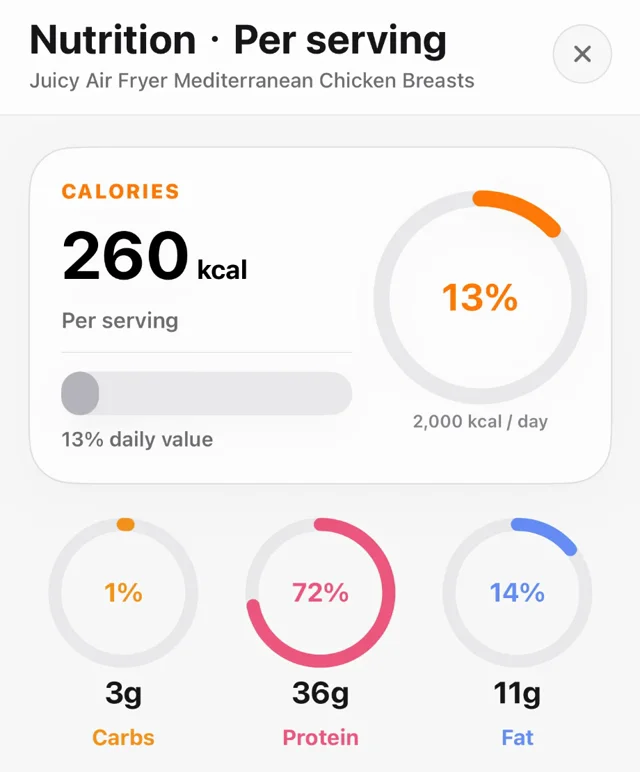
In Hireci, recipes you’ve saved show estimated calories, protein, carbohydrates and fat per serving, worked out from the recipe’s ingredients and its number of servings. The estimate is only as good as what it starts from, so check the imported quantities and the servings first. When a recipe doesn’t state its yield, Hireci estimates one and labels the nutrition Estimated per serving. If that doesn’t match what you make, change the servings on the recipe; the next time you open its nutrition, it’s worked out again for the new yield. Nutrition analysis needs a Hireci+ subscription; the app is free to download for iPhone and iPad.
Whichever you use, treat the result as a good estimate rather than a lab measurement. Database values are averages, and your beef, your beans and your pour of oil won’t match them exactly.
Your recipe-calorie checklist
- Weighed every ingredient in grams, including the oil and toppings.
- Matched each database entry to how it was weighed: raw or cooked, dry or drained.
- Subtracted fat you poured off and frying oil left in the pan.
- Added up the whole pot before dividing.
- Divided by the servings you actually make, or by the finished weight.
- Saved the totals with the recipe for next time.
Frequently asked questions
Do calories change when you cook food?
Not much. Cooking mostly adds or removes water, which changes the calories per 100 g but not the total in the pot. The exceptions are fat you pour off, oil the food absorbs, liquid you throw away and alcohol that cooks off.
Should I weigh meat raw or cooked?
Either works if the database entry matches. For a recipe, raw is easier because you weigh it before it goes in the pan; USDA FoodData Central lists both raw and cooked entries for most meats.
How accurate are recipe calorie calculators?
Only as accurate as the amounts you enter and the entries each line is matched to. Database values are averages, so expect a careful count to be close rather than exact, and check any line that looks off.